Image by FlamingText.com

Wednesday, May 7, 2008

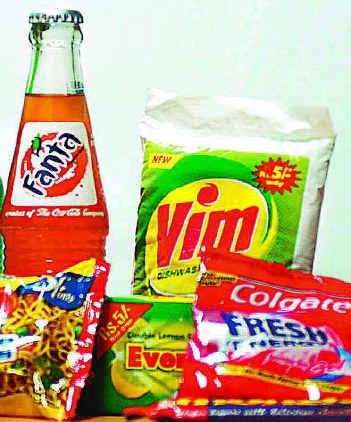
FMCG prices up on higher input costs

The rise in raw material costs has caused a 10 per cent increase in the retail prices of fast-moving consumer goods as companies are passing on the rise in costs.

In the last few weeks, the price of the 100 gram bar of Godrej No 1 has gone up by Rs 2.5 to Rs 13, Wipro's [Get Quote] Santoor by Rs 2 to Rs 16, Reckitt Benckiser's Dettol by Rs 2 to Rs 17 and Hindustan Unilever's Pears by Rs 2 to Rs 23. Even mass market brand Lifebuoy, the largest selling, has become costlier by Re 1 to retail for Rs 12.

Food items, too, have become costlier. "We had increased milk prices in February 2007, August 2007 and then again in February 2008 - each time by Re 1. We also raised the prices of select items such as ice-creams by 1-2 per cent in February," said R Sodhi, chief general manager, Gujarat Cooperative Milk Marketing Federation, which markets the ubiquitous Amul.

Procter & Gamble's Ariel detergent now costs Rs 122 for a 1 kg pack, a rise of Rs 6, while HUL's Surf Excel's price is up at Rs 126, costlier by Rs 10. In some cases, the prices have remained unchanged but packs have become lighter. The 1 kg pack of HUL's Wheel washing powder has shrunk to 800 gm.

However, HUL has bucked the trend in the case of Lux, its flagship soap brand, deciding to roll back the 5 per cent price increase it had effected earlier.

"This is consequent to the excise duty reduction announced in the Union Budget for home and personal care products from 16 per cent to 14 per cent, along with changes in abatements," said a spokesperson for the company.

This is an act unlikely to be replicated. The price of palm oil, which comprises 80 per cent of the raw material in soap making, has gone up by 9 per cent since January. Soda ash, a key ingredient in detergents, has become costlier by 20 per cent in the last six months to touch Rs 9,000 a tonne.

Since January 1 this year, the price of groundnut oil has gone up 7.81 per cent, sugar by 9.34 per cent and wheat by 3.09 per cent.

A temporary relief for some players is a forward contract cover for vegetable palm oil for the next three to six months. However, once this contract ends, the new contract will be based on the increased prices and put still more pressure on consuming companies.

"The way the prices of raw materials are increasing, the indications are that we would need to take another price hike. We are contemplating a price hike of up to 6-8 per cent in soaps," said Hoshedar Press, executive director and president, Godrej Consumer Products [Get Quote].

ITC is dealing with the situation by building scale. The company has also dispersed its manufacturing base, reducing the time and distance to market.

Saturday, April 19, 2008

Marks & Spencer to tango with Reliance

Britain's leading retailer Marks and Spencer Group (Marks & Spencer) announced a JV with Mukesh Ambani-promoted Reliance Retail on Friday, involving an initial investment of £29 million (Rs 230 crore), with plans to set up 50 stores over the next five years. M&S plans to pick up majority stake of 51% in the JV, Marks and Spencer Reliance India, while the balance will be held by Reliance Retail, once its application is cleared by the foreign investment promotion board. The UK-based clothing and food retailer expects to increase sourcing from India and bring into the country a wide range of products from its global portfolio through its proposed stores. "We intend to open bigger stores, selling a wider range of products at lower prices, including a growing number of products sourced from local suppliers,'' Marks and Spencer Reliance India CEO Mark Ashman said. "Subject to FIPB approval, we will open our first store in six to nine months. To begin with, the focus will be on cities like Delhi, Mumbai, Hyderabad and Bangalore, and in next couple of years we will also go to tier II and tier III cities,'' he added. The new JV will have the right to operate Marks & Spencer stores in India selling items such as women's, men's and children's clothing as well as homeware. Planet Retail, Marks & Spencer's existing franchise partner in India, will continue as a franchisee in respect of the 14 existing franchise stores, says a company statement. This announcement is part of Marks & Spencer's plans to grow its international business to 15-20% of group revenues within the next five years. Stuart Rose, CEO, Marks & Spencer said: "India is a very exciting opportunity for Marks & Spencer and a market where there is the potential for M&S to become a major retail brand. Reliance Retail is the ideal partner for us to accelerate our expansion and create the opportunity to open much bigger M&S stores. We have been very impressed by their strength in technology, logistics and property and the speed with which they have become a major player in India's retail scene.'' The JV is at present called Tapti Trading. Commenting on the development, Reliance chairman Mukesh Ambani said: "M&S is a very well respected brand globally. At Reliance, we have always strongly believed in the power of the Indian consumer market. We are excited to partner with M&S to combine Reliance's understanding of the Indian marketplace, and its traditional strengths in the areas such as technology, infrastructure, logistics and training with M&S's legendary retailing and product development capabilities to deliver a delightful experience for Indian consumers.'' The £8.5-billion M&S employs over 75,000 people in over 600 stores in UK, and over 275 stores in 39 territories around the world.

Rasna set to foray into fast food

In a major diversification move, Ahmedabad-based soft drink concentrate major Rasna is cooking up a foray into the fast food mart with an exclusive chain of outlets retailing fast food and beverages. To be christened Devil's Workshop, Rasna's fast food chain is aimed at not just taking on industry biggies like McDonald's but also cafe majors like Barista and Cafe Coffee Day as well.
The diversification move has been brewing for the past six months and has seen Rasna set up a separate division to be spearheaded by a CEO, apart from a central kitchen at a cost of Rs 1.5 crore in A h m e d ab a d , sources said. Rasna plans to set up small outlets of around 600 sq ft and kiosks at malls, multiplexes, educational institutions and transpor tation hubs, sources added. Interestingly, while the National Institute of Design was roped in to design the concept as well as outlets, Rabo Bank carried out the viability study.
The outlets, the first of which are to be rolled out on a pilot basis at a multiplex in Ahmedabad this weekend, will retail not just fast food delicacies like pizzas, croissants and patties but also donuts, pastries as well as hot and cold beverages. While the cold beverages will come from the Rasna stable, the company has joined hands with Italian coffee player Caffe Vergnano for its coffee offerings, sources said. When contacted, Piruz Khambatta, chairman of the Rs 300-crore Rasna group, confirmed the move and said the company was eyeing revenues of nearly Rs 100 crore from the food business by 2009-end.
"We plan to target nearly a dozen tier-II cities, including Pune and Chandigarh, for the fast food business, for which we will also take the franchisee route,'' Khambatta said, adding that the company will set up a central kitchen in each city it enters. Explaining the reason for the foray, Khambatta said: "We found that the biggest growth in the food retail segment is coming from ready-to-eat foods due to changing lifestyles and onset of modern retail.''

Monday, March 31, 2008

India ranks 44 as global retail destination

India has been ranked 44th on the list of most preferred destinations by global retailers, according to a report by real estate consultant CB Richard Ellis.

The report explores the globalisation of the retail industry and scrutinises retailer presence in relation to market sectors, country of origin, regional trends and other influences.

"Even though the Indian economy is growing at a rapid pace with consumers having more buying power, we are still only at the 44th position," said Anshuman Magazine, chairman and managing director of CB Richard Ellis (South Asia).

"This is primarily due to FDI (foreign direct investment) restrictions in retail and also relatively lower average per-capita income in the country. Hopefully in the future, if the FDI norms are relaxed, coupled with expected economic growth, India would move up in the rankings," Magazine added
Among the BRIC (Brazil, Russia, India and China) group of countries, only China and Russia have been able to make it to the top 10.

Britain leads the chart with the presence of 55 percent retailers, Spain second with 51 percent retailers followed by France, a close third with 49 percent retailers.

France and Germany also performed strongly in the global ranking, achieving third and fourth positions respectively. The United Arab Emirates, China and Russia figured in the top 10, the report said.

"The penetration of international retailers into these emerging markets is similar to that of much more mature economies, explained by a number of domestic political, economic and retail market idiosyncrasies," it said.

Interestingly, the US was ranked 11th with the presence of 39 percent of international retailers.

Presence of luxury goods dominated the international retail expansion, with almost 90 percent having a presence in more than 10 markets, whereas grocery, food and drink retailers indicated 60 percent presence in 10 or more markets.

Retail biggies discover future in hypermarket format

Hypermart is the flavour of the season. The big guns of organised retail have entered new markets with small-sized supermarkets and branded convenience stores. Now they are ready for bigger investments and larger formats.

Reliance, Aditya Birla and Tata’s Star Bazaar are focusing on large European-style hypermart roll-out while old hands like Spencer’s and the Future Group too are scaling up their hypermart formats. Hypemarket are the next stage in retail revolution for some brands. They will get higher margins, volumes and more brand recognition.

“The supermarts have already established brands, now hypermarts can levearge that brand recognition and create a captive customer in smaller markets. European style of hypermarket with roomy isles and white lights seems to be favoured by the new players in India”, says a marketing consultant attached to an Indian retail business house.
According to a Technopak study, 66% of the total domestic investments in retail (estimated to be at $1,011 billion by 2017) would be done in hypermarts and supermarts formats. In the next five years, 32% of the new investment in retail is expected to be in the hypermarkets, says the study.

Typically, a hypermarket is weekend shopping destination that works on low price points and high volumes, covers a large floor area (anything from 40,000 square feet to 200,000 square feet) and has a larger catchment area. It is a combination of supermarket and departmental store and stocks a large amount of product categories, including groceries, general purpose goods to specific apparel and even automobiles etc.

The Tata, Reliance and Aditya Birla groups have by co-incidence of design launched their hypermarts in Gujarat during the beginning of this year. For most, it was a combination of easy availability of property in a reasonably mature market. “There was property easily available since retail development had commenced in Ahmedabad.

Since the hypermarket business was new to us, we wanted to test in a market that was value-conscious and gauge the results before spreading our footprint across the country,” Smeeta Neogi, brands head, Trent, told ET. Russell Burman CEO, hypermarkets, Aditya Birla Retail, says that the Gujarat opening and timing of hypermart is a coincidence.

“We have been planning it for sometime. It has more to do with which property developed early,” he said. More is planning to open some dozen hypermarts this year in NCR and across tier two cities in India. Reliance, which has already opened two hypermarts in Gujarat, is also rolling out the retail model across the country.

Big retailers to take care of mom-&-pop stores

India Inc is all set to script an Indian model for retail growth. The government has asked big retailers to chart out an India-specific strategy for organised retail, which would result in inclusive growth of mom-&-pop outlets.

“We have had two rounds of meetings with retailers such as Reliance, AVB Group, Future Group, Bharti and the Tatas,” minister for food processing industries Subodh Kant Sahay told ET. “We want small shopkeepers to get access to big supply chains. Everybody should benefit,” he said. This could be the answer to the political criticism over large retail trampling small kirana shops.

“Organised retail, in the long term, would create a market as it would help boost supply-chain management for our farm produce also. Without retail, farmers cannot get optimum value for their produce. Due to lack of an efficient supply-chain network, more than half of India’s produce gets wasted,” Mr Sahay said.

India could consider opening up its $330-billion retail market to foreign investment after it is convinced that the kirana stores will not be affected by big retailers. “Organised retail, backed by an efficient supply chain, has the potential of raising the rate of growth of the food processing sector from 13% to 20% in the next three to five years,” the minister added.

Last year, states like Uttar Pradesh cracked down on organised retail, especially in fruit and vegetables, following protests from vendors. This sector has a strong lobby of middlemen, who control significant chunks of local vote banks.

Saturday, March 29, 2008

same old storey

Considering that the apparel and lifestyle retail format, Shopper’s Stop is one of the oldest players in Indian retail, BS Nagesh and his team can feel a sense of achievement. But the oldest network also brings a rider along — that Shopper’s Stop has the largest number of old stores. This for the team is a matter of concern because in addition to launching new stores across new regions, the old stores also need a boost from time to time. Currently, there are four stores under revamp across Delhi, Hyderabad and Bangalore. “If you open three or four stores a year, they look newer and your first 20 stores look older. So in your own generation, yesterday’s business looks extremely old,” says B S Nagesh, CMD, Shopper’s Stop. While one can see the thought behind the revamp of older stores within Shopper’s Stop network, it’s only 18 months since the Croma store at Juhu opened for business and already changes are in the offing. Not because footfalls or per square feet realisation is dropping, but the idea here is to create a more customer friendly environment. “When sales are good, the normal logic is don’t touch it. But in the last 18 months, we have studied customer traffic. Based on what we found out, we have decided to incorporate some changes,” explains Ajit Joshi, CEO, Infiniti Retail. The retailers today are doubling up as cosmetic surgeons undertaking elaborate makeover sessions. The intervention has been necessitated by worries about same store sales, a phenomenon which has hit the Indian retailing market. As players are leapfrogging the retail curve and aggressively expanding, they are faced with shorter retail lifecycles on older stores. Globally, average retail life cycles are six to seven years but Indian modern retailers have been forced to re-invest in old stores by the third year on account of the rapid pace of expansion. Same store sales are generated only by establishments that have been open more than a year and give a clear sense of how the industry is really performing. It is crucial since the older stores bring in most of the business until newer ones consolidate their position. Globally , the same stores metrics are used to measure the health of the business and are also a trademark of the health of the economy particularly in countries with a developed retail environment. It’s this phenomenon which is keeping Salil Sahu, CEO, Home Stores India, which runs Sabka Bazaar in the North on his toes despite a complete revamp recently. Home stores, part of Wadhawan retail holdings, acquired Sabka Bazaar in July 2007. Post acquisition, the company revamped all 30 existing stores while adding new ones to its fold. Six months into business, old store sales have grown by 50%, while footfalls grew by 70%, says Sahu. “A reasonable timeframe can be four years before a major overhaul is undertaken , but changes are taking place in all directions , from cost pressures , competition to shopper behaviour. Thus one needs to constantly monitor the need for incremental changes from time to time,” he explains. Industry estimates indicate the retailers target between 5% and 15% same stores sales growth depending on inflation and shape of the economy. India however is witnessing erratic behaviour. Considering the nascent stage, the growth should be increasing consistently. However, studies reveal that while stores do better in the first year, the second year witnesses a drop. Hemant Kalbag, principal - consumer & retail practice, AT Kearney believes the drop is more to do with the novelty factor associated with a store. Since retail is a new phenomenon , barring big metros, most catchments haven’t got exposed to modern trade.

Wednesday, March 26, 2008

India among 'most brand conscious countries' globally

A fast growing economy and a rising number of affluent consumers have pushed India into the league of most brand conscious countries globally, says a survey.

In the 'Nielsen Global Luxury Brands Study', India was placed at the third position after Greece and Hong Kong.

According to the survey, 35 per cent Indian respondents agreed to buying designer brands. On the other hand, about 46 per cent people in Greece and another 38 per cent in Hong Kong responded positively to having bought such brands.

Interestingly, the study conducted by global information entity Nielsen Company found that despite the prevalence of imitated designer-branded goods, more than three-fourth of Indians do not believe that imitation products match up to the real one.

While 34 per cent of respondents were found to have spent on Calvin Klein brand, 25 per cent preferred Gucci and another 24 per cent spend money on Diesel. About 16 per cent Indian consumers spent on Christian Dior and 10 per cent on DKNY.

About 26,312 internet users in 48 markets across Europe, Asia Pacific, North America and Middle East were surveyed in November 2007. About 500 interviews were conducted in India.

"Foreign brands are synonymous to status and our survey finds that 57 per cent of Indians surveyed buys designer brands as a status symbol," The Nielsen Company Associate Director (Client Solutions) Vatsala Pant said in a statement.

In terms of brands, 41 per cent Indians prefer to buy the products of Italian brand Gucci, making it the top country for this brand in the Asia Pacific region, followed by Philippines (39 per cent) and Indonesia (37 per cent).

Meanwhile, the survey said if money was not an issue, Gucci (41 per cent), Calvin Klein (31 per cent), Christian Dior (26 per cent), Versace (25 per cent), Diesel and Giorgio Armani (both 22 per cent each) are the "most coveted" brands for the Indian consumers.

Pointing out that local brands are popular among Indian consumers, the study said 40 per cent of respondents in the country are buying these brands.

"This is the sixth highest percentage globally for a country that buys local brands," it added.

Even though 73 per cent Indians feel that designer brands are usually overpriced for what they are, 35 per cent also believe that these brands are having a higher quality.

However, 45 per cent Indian consumers think that only fashion conscious people consider buying designer brands.

Another interesting fact is that consumers in the country approved the potential of a crossover product between a designer fashion brand and a new technology gadget.

"...56 per cent Indians surveyed would buy a mobile phone that was co-branded with a luxury brand... 40 per cent said they would buy a co-branded designer laptop computer, 32 per cent a 'designer' flat screen TV...," the statement added

Monday, March 24, 2008

Coke to pump more money to make India top 5 markets: CEO

Betting big on India's potential to emerge its top five markets in the world, Cola giant Coca Cola on Monday committed to more "incremental" investment on top of Rs 1,000 crore it will pump by 2011. "We are bullish on India. It is a matter of stimulation... as the growth comes, you have to put in incremental investments," E Neville Isdell Chairman and CEO of US-based multinational Coke said. "We are investing 250 million dollars (Rs 1,000 crore)... this will not be the last. More investments will come," Isdell, who is visiting India as part of pushing business in tandem with a pleasure trip, said. Dubbing Coca Cola (India) as a "profitable" venture that is adding to the balance sheet of the global giant, the CEO said, "We have arrived in India. But we have not arrived to the level where we want to." "It is a question of long-term commitment. India figures in the global growth strategy of Coke. We are going to make it among the top 10 countries for Coke and then later among the top five," he said, but did not give any time frame on whether the first milestone would be achieved in five years or less. Stating that India is currently at number 17 in the list of countries where Coke is present, Isdell said the country had emerged among the best markets for the company during the year 2007.

New cleaning solutions from Henkel

Henkel India introduced its new Bref range of disinfectant-cleaning solutions in Chennai on Thursday. This includes a hard-surface power cleaner, a toiler-cleaner and an in-cistern block. “The advantage of the power cleaner is that it is available in foam form and can even be applied on vertical surfaces,” Henkel India managing director A Satish Kumar told the media. They expect the new range to contribute to about 5% of the company’s turnover in the coming fiscal. The cleaning solutions market (both hard surface and toilet cleaner segments) is estimated at Rs 373 crore. In the last four years, the industry has shown a CAGR of 24%. The segment contributes roughly Rs 25 crore to the company’s Rs-500 crore business in India. Market penetration of toilet cleaners is under 10% in the country, but is growing fast, Mr Kumar said. Bref Power Cleaner would be available in a 400 ml pack priced at Rs 75, while the Toilet Cleaner will be available in 200 ml (Rs 22) and 400 ml (Rs 50) packs. The incistern block would be available in 50-gm block priced at Rs 50.